Gained experience working in an interdisciplinary team with designers and developers. Conducted user research through interviews and surveys, designed wireframes and prototypes, which we developed in Android Studio using Kotlin and MET Norway’s API. Also contributed to front-end development.
UX-design
Kotlin
Scrum
Front-end


UX-Designer
Research, wireframing, prototyping, user-testing.
Duration
1 semester
Date
Spring 2021

The target audience consists of year-round swimmers, aged 18-50, who are engaged and exploratory. We recruited participants through Facebook swimming groups and personal networks to gather insights for the app.
We chose Scrum for its flexibility, iterative approach, and focus on collaboration, which helped us stay organized and adapt throughout our first school project.
To better understand our target group, we used semi-structured interviews for in-depth insights and surveys for broader validation. From interviews and surveys, we gained a better understanding of the problems and needs of year-round swimmers.
Beyond the design role, I also worked with modeling to understand the system as a whole. Using models to describe and illustrate key functions helped us better understand the interactions.


Prototyping high-fidelity flow of interaction
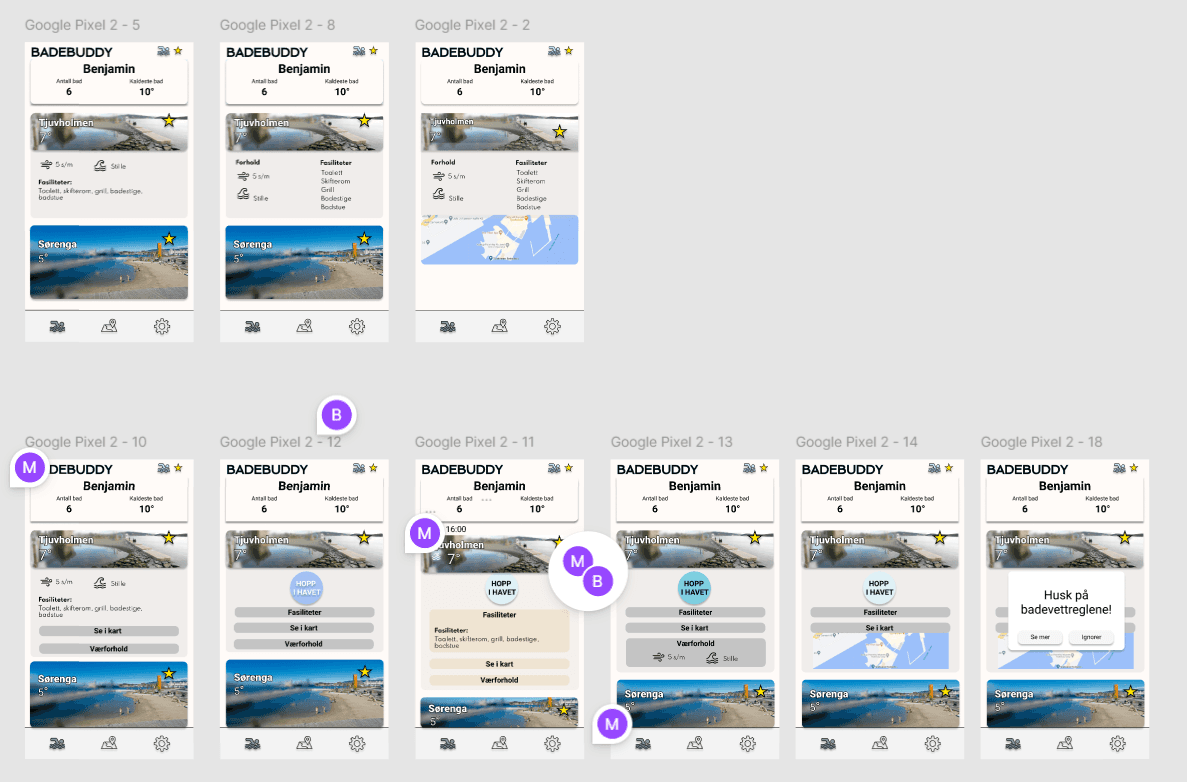
Five user tests were conducted with different participants, although some were not ideal representatives of the target group due to limited access during the pandemic. The main issues identified were non-functioning features that disrupted user flow, such as the map search and navigation to the main menu. Additionally, users confused sauna icons with toilets and misunderstood some interface elements. These issues were addressed and included as tasks for the next sprint.

The pandemic limited user testing.
Lack of user insight from the pandemic.
Conducting consistent structured testing and lacking a unified plan.
We faced issues with merging and syncing, causing delays in the workflow.
In the future, the project could benefit from more diverse user testing, feature improvements, better API performance, and automation of testing tools.